
The Short Answer
In 2026/27 PIP pays £121.20 to £778.40 every 4 weeks, which averages £131.30 to £843.27 per calendar month. PIP is paid every 4 weeks rather than monthly, so a year contains 13 payments, not 12. The amount depends on your award: standard daily living alone pays £306.80 every 4 weeks, and both enhanced rates together pay £778.40. The table below gives the 4-weekly payment, monthly average and yearly total for every combination.
Key facts
| Fact | Figure | Source | Checked |
|---|---|---|---|
| PIP every 4 weeks (2026/27) | £121.20 to £778.40 | GOV.UK | 30 September 2026 |
| Calendar-month average (2026/27) | £131.30 to £843.27 | GOV.UK | 30 September 2026 |
| PIP a week (2026/27) | £30.30 to £194.60 | GOV.UK | 30 September 2026 |
| How often PIP is paid | Usually every 4 weeks, in arrears | GOV.UK | 30 September 2026 |
How much is PIP per month?
One 4-weekly PIP payment is 4 × your weekly award, and in 2026/27 that means £121.20 to £778.40 depending on the components. The underlying weekly figures are the four national amounts you can check pip rates against at any time. The conversion for all 8 paying awards:
| Award (2026/27) | Weekly | Every 4 weeks | Calendar-month average | Per year (13 payments) |
|---|---|---|---|---|
| Mobility standard only | £30.30 | £121.20 | £131.30 | £1,575.60 |
| Daily living standard only | £76.70 | £306.80 | £332.37 | £3,988.40 |
| Mobility enhanced only | £80.00 | £320.00 | £346.67 | £4,160.00 |
| Both standard rates | £107.00 | £428.00 | £463.67 | £5,564.00 |
| Daily living enhanced only | £114.60 | £458.40 | £496.60 | £5,959.20 |
| Daily living enhanced + mobility standard | £144.90 | £579.60 | £627.90 | £7,534.80 |
| Daily living standard + mobility enhanced | £156.70 | £626.80 | £679.03 | £8,148.40 |
| Both enhanced rates | £194.60 | £778.40 | £843.27 | £10,119.20 |
Last checked:
The two right-hand columns differ because 52 weeks divide into 13 payments, not 12. Budgeting by calendar month therefore understates the year by one payment: the average column corrects for it by spreading 52 weeks across 12 months.
Daily living component
Standard rate
£332.37 a month on average
- a week
- £76.70
- every 4 weeks
- £306.80
- a year
- £3,988.40
Enhanced rate
£496.60 a month on average
- a week
- £114.60
- every 4 weeks
- £458.40
- a year
- £5,959.20
Mobility component
Standard rate
£131.30 a month on average
- a week
- £30.30
- every 4 weeks
- £121.20
- a year
- £1,575.60
Enhanced rate
£346.67 a month on average
- a week
- £80.00
- every 4 weeks
- £320.00
- a year
- £4,160.00
Both components at the enhanced rate
- a week
- £194.60
- every 4 weeks
- £778.40
- a month on average
- £843.27
- a year
- £10,119.20
PIP is paid every 4 weeks, so a year holds 13 payments; the monthly figure spreads 52 weeks across 12 months. Rates for 2026/27 apply from April 2026.
Last checked:
Source: GOV.UK, PIP: how much you'll get (2026/27 rates)
The amounts are the same for every condition, because points decide the money and the diagnosis carries none; condition-by-condition points guides, such as PIP for Crohn's Disease, cover how an award is reached. Back pay for the weeks before a decision is a separate lump sum, explained in how pip back pay works.
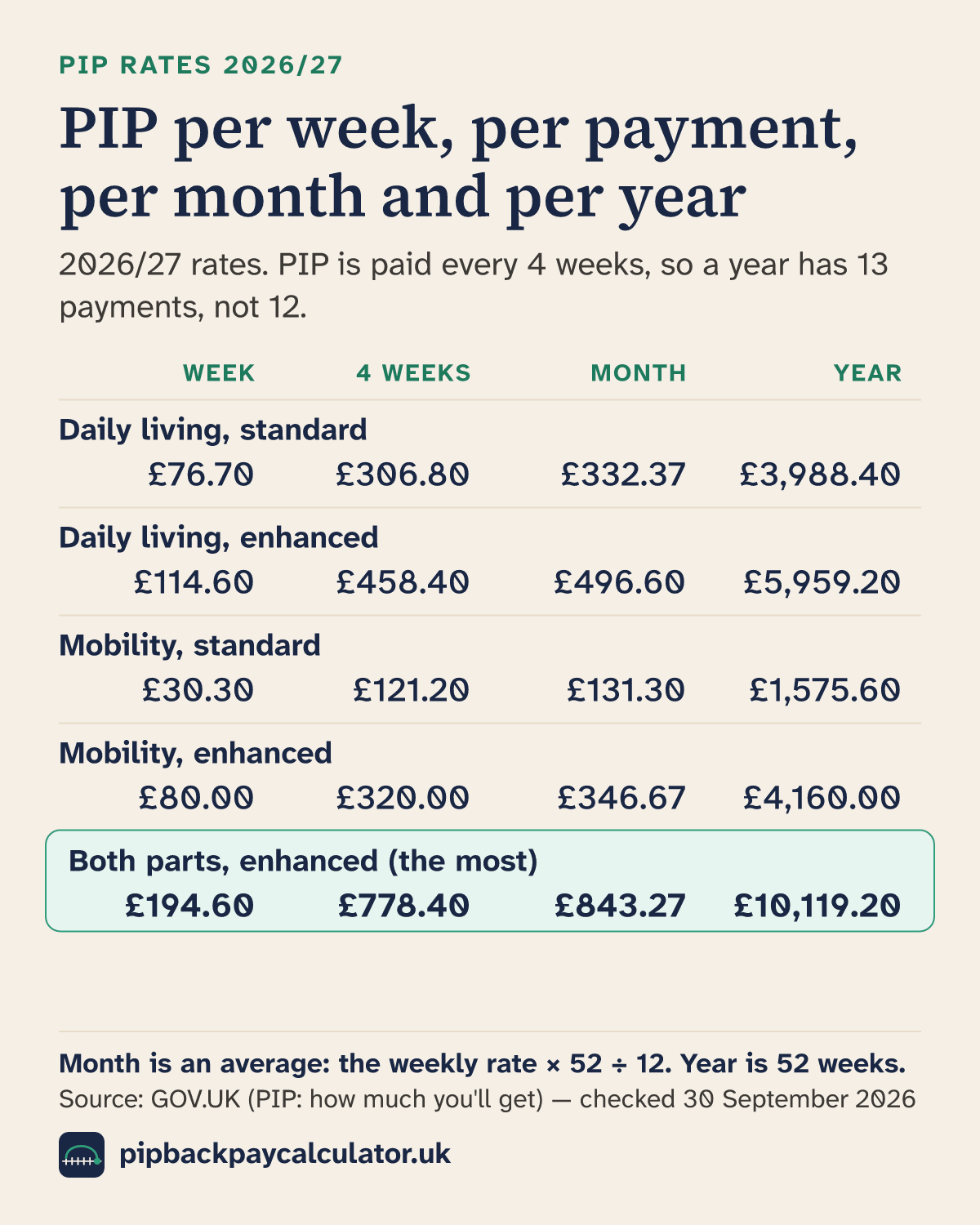
In 2026/27 the highest PIP award, both parts at the enhanced rate, is £194.60 a week, £778.40 per 4-weekly payment, £843.27 a calendar month on average and £10,119.20 a year.
Last checked:
PIP Amounts in Detail
The 4-weekly cycle explains most surprises in PIP amounts. Payments land every 28 days, so payment dates drift through the calendar rather than repeating on the same date each month. About once a year a calendar month contains two payment dates, which is the 13-payment pattern arriving, not an error.
The cycle also explains first payments. A new award starts with the backdated lump sum, then settles into the 4-weekly rhythm from the date the decision letter gives. From that point each payment is identical until the rates change in April or the award itself changes.
Comparing PIP's monthly worth against monthly-paid benefits needs the 13-payment correction in reverse: a benefit paying £400 calendar-monthly delivers £4,800 a year, while PIP at £400 per 4-weekly payment delivers £5,200. Like-for-like comparisons should always run through the annual figure.
Amounts on this page assume the 2026/27 rates in force since April 2026. Weeks from earlier years inside a back-pay window use their own years' figures, which is why arrears estimates always ask for dates.
Monthly budgeting on a 4-weekly benefit
The mismatch between payment cycles and bills has one clean solution: budget on the 4-weekly amount and treat the thirteenth payment as the correction. Rent, energy and subscriptions bill monthly, so most months of the year contain one PIP payment and about one month contains two. Planning against the single-payment figure keeps every month covered, and the double-payment months arrive as slack rather than shortfall.
The annual view makes the same point with totals. Standard daily living pays £3,988.40 across 52 weeks; both enhanced components pay £10,119.20. Dividing those by 12 produces the calendar averages in the table, and dividing by 13 reproduces the 4-weekly payment. All three views describe the same money on different clocks.
Last checked:
When the monthly amount changes
Only three events move the figures. April uprating lifts every rate, and the first payment covering post-April weeks arrives at the new amount automatically. An award change after a review, reconsideration or tribunal replaces the weekly rate the cycle multiplies. And a component ending, at award end or after a change of circumstances, removes its share from the payment. Nothing else, including work, savings and other benefits, touches the amount that lands.
The figures above are the complete monthly answer; everything else is the award behind them.
Work Out Your Number
Select your award and read the weekly, 4-weekly and yearly figures at once: work out your pip amounts with the PIP Rates Calculator.