
The Short Answer
A PIP points calculator adds up the descriptor points you select across 12 activities, and 8 points in a component pays the standard rate while 12 pays the enhanced rate. Ten daily living activities and two mobility activities are scored separately. Those thresholds are set by regulations 5 and 6 of the PIP Regulations 2013, and the points in the two components are never added together. The calculator above uses the verbatim Schedule 1 wording.
How PIP Points Work
PIP points measure how difficult you find 12 activities, and the PIP Back Pay Calculator UK network of tools starts from exactly that score. Ten activities feed the daily living component and two feed mobility. In each activity you match yourself to one lettered descriptor, and the highest descriptor that applies carries the points.
| Component | Activities | Points route to an award |
|---|---|---|
| Daily living | 10, from preparing food to making budgeting decisions | Points from all 10 add together |
| Mobility | 2: planning and following journeys, moving around | Points from both add together |
Last checked:
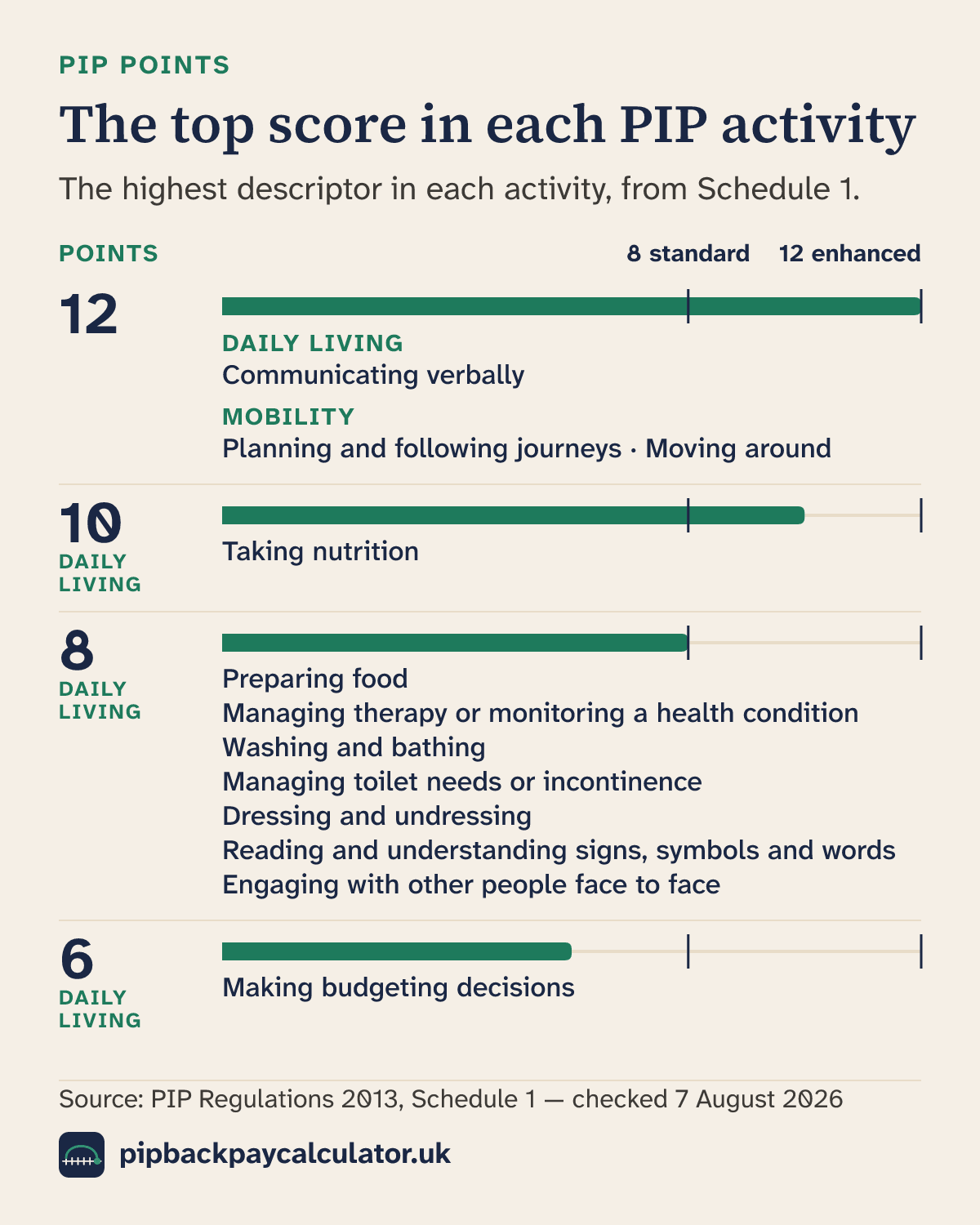
The highest descriptor in each of the 12 PIP activities scores between 6 and 12 points, and three activities can reach the 12-point enhanced threshold on their own.
Last checked:
How Many Points You Need
At least 8 points in a component pays its standard rate, and at least 12 pays enhanced, under regulations 5 and 6 of the PIP Regulations 2013. The components score independently, so any combination of awards is possible.
| Points | Daily living | Mobility |
|---|---|---|
| 0 to 7 | No award | No award |
| 8 to 11 | Standard: £76.70 a week | Standard: £30.30 a week |
| 12 or more | Enhanced: £114.60 a week | Enhanced: £80.00 a week |
Last checked:
What Each Activity Scores
Every activity has a fixed maximum, and the maximums shape how awards are reached. Daily living builds through breadth; mobility can reach enhanced through one activity. Three tools score one area at a time: Daily Living Points Calculator, Mobility Points Calculator and Walking and Moving Around Points Calculator.
| Activity | Component | Maximum points |
|---|---|---|
| 1. Preparing food | Daily living | 8 |
| 2. Taking nutrition | Daily living | 10 |
| 3. Managing therapy or monitoring a health condition | Daily living | 8 |
| 4. Washing and bathing | Daily living | 8 |
| 5. Managing toilet needs or incontinence | Daily living | 8 |
| 6. Dressing and undressing | Daily living | 8 |
| 7. Communicating verbally | Daily living | 12 |
| 8. Reading and understanding signs, symbols and words | Daily living | 8 |
| 9. Engaging with other people face to face | Daily living | 8 |
| 10. Making budgeting decisions | Daily living | 6 |
| 1. Planning and following journeys | Mobility | 12 |
| 2. Moving around | Mobility | 12 |
Last checked:
From Points to Money
Your score converts to weekly money the moment a threshold is crossed, at the four current rates. The full rate tables, 4-weekly totals and April uprating mechanics sit in PIP Rates 2026/27, and the wording behind every descriptor in PIP Descriptors and Points. The weekly PIP daily living rate for every year since 2022 is tabled separately.
The conversion in full, for any pair of component scores:
| Daily living score | Mobility score | Weekly total |
|---|---|---|
| 8 to 11 | 0 to 7 | £76.70 |
| 12 or more | 0 to 7 | £114.60 |
| 0 to 7 | 8 to 11 | £30.30 |
| 0 to 7 | 12 or more | £80.00 |
| 8 to 11 | 8 to 11 | £107.00 |
| 8 to 11 | 12 or more | £156.70 |
| 12 or more | 8 to 11 | £144.90 |
| 12 or more | 12 or more | £194.60 |
Last checked:
Beyond the weekly figure, a score that supports an award also supports arrears from your claim date if a decision is still pending, which is where the back pay calculator continues the arithmetic this one starts.
Does the PIP Calculator Work for Adult Disability Payment?
For the points, yes: Adult Disability Payment in Scotland is scored across 12 activities, with the same 8-point and 12-point thresholds as PIP. Regulation 8(3) of the Disability Assistance for Working Age People (Scotland) Regulations 2022 gives the daily living standard rate for "at least 8 points and no more than 11 points" and the enhanced rate for "at least 12 points"; regulation 9(3) sets the same bands for mobility. Social Security Scotland pays ADP at the same weekly amounts as PIP in 2026/27.
| PIP (England and Wales) | ADP (Scotland) | |
|---|---|---|
| Paid by | DWP | Social Security Scotland |
| Activities scored | 12: 10 daily living, 2 mobility | 12, across daily living and mobility |
| Standard rate | 8 to 11 points in a component | 8 to 11 points in a component |
| Enhanced rate | 12 points or more | 12 points or more |
| Daily living a week | £76.70 standard, £114.60 enhanced | £76.70 standard, £114.60 enhanced |
| Mobility a week | £30.30 standard, £80.00 enhanced | £30.30 standard, £80.00 enhanced |
Last checked:
The descriptor wording inside this calculator is the UK PIP schedule. ADP's activities and descriptors are set out in Part 2 of schedule 1 to the Scottish regulations, so a borderline activity is worth reading against that schedule as well. The process around the score is where the two benefits part company: ADP uses consultations rather than assessments, and a re-determination rather than a mandatory reconsideration, as the guide to Adult Disability Payment explains.
How This Calculator Differs From the Assessment
The tool applies the same law as a DWP assessment but not the same process, and the differences define how to use the result. The thresholds are the statutory ones: regulations 5 and 6 of the PIP Regulations 2013 set 8 points in a component for the standard rate and 12 for the enhanced rate. The assessment weighs evidence: your form, medical reports and an assessor's observations decide which descriptors are found to apply, with the reliability and majority-of-days rules applied to that evidence. The calculator takes your own descriptor choices as given. Honest answers therefore produce a realistic ceiling-and-floor picture, while optimistic answers produce a number the evidence will not support.
Used before a claim, the score shows whether the thresholds are realistically in reach and which activities carry your claim. Used before an assessment, it maps the questions to prepare for. Used after a decision, it frames whether the awarded descriptors match your reality activity by activity, which is exactly the comparison a mandatory reconsideration letter needs to make.
Reading Each Activity's Descriptor Ladder
Every activity's descriptors climb the same ladder, and recognising the rungs makes selection faster and more accurate. The bottom rung is always unaided ability at 0 points. The next rungs add aids and appliances, then prompting, then supervision, then assistance, in roughly rising point values, before the top rung of complete inability. Your task in each activity is finding the highest rung that describes the majority of your days.
Three rungs are chronically under-selected. The aids rung applies whenever equipment is needed for safe or acceptable performance, including equipment you improvised: a perching stool, a shower seat, or furniture used for support all count. The prompting rung applies when another person's reminding or encouragement is needed, even where no physical help is: unprompted, the task does not happen, or does not happen adequately. And the supervision rung applies where someone must be present for safety, whether or not they ever intervene, which is the reality of seizure risks, falls and overdose-risk medication.
The descriptor language repays exact reading in both directions. Cook means heat food at or above waist height; a microwave-only cook belongs on descriptor c of preparing food, not descriptor a. Engage socially requires interaction that is contextually appropriate, so masking through encounters at real psychological cost is not unaided engagement. Reading your days against the words, rather than your self-image against the activity names, is what makes a self-score match what the law would actually award.
The full verbatim ladders for all 12 activities, with every sub-limb, sit in PIP Descriptors and Points; this calculator carries the same text inside each activity's options.
How to Answer the 12 Activities Accurately
The calculator is only as accurate as your descriptor choices, and three habits keep them honest.
- Answer for the majority of your days, not your good ones: a descriptor applies if it reflects more days than not, so a bad-week reality outweighs a good-day performance.
- Count help you receive and help you need but push through without: prompting, supervision and assistance all count whether or not anyone currently provides them.
- Apply the reliability test to every yes: a task you cannot do safely, to an acceptable standard, repeatedly and in a reasonable time is a task the law says you cannot do.
Common self-scoring errors run in one direction. People who cook with a microwave because a conventional cooker is unsafe still tick descriptor a. People reminded to take medication daily tick unaided. People who walk 100 metres once, then cannot repeat it, claim more than 200. Each error costs points the descriptors intend to award, and each is fixed by reading your own days rather than your self-image.
Worked profiles show how ordinary situations become scores. Needing aids in four daily living activities reaches 8 points and the standard rate. Needing prompting across cooking, engaging with people and medication, common in mental health claims, reaches 5 and needs one more scoring activity for an award. On mobility, being unable to walk more than 50 metres reliably reaches 8 points at minimum, and 20 metres reaches 12.
If Your Score Looks Too Low
A low score here describes your answers, not your entitlement, and two follow-ups are worth making before drawing conclusions. First, check your answers against the reliability rules: an activity you cannot do safely, to an acceptable standard, repeatedly and in reasonable time scores as if you cannot do it, and answers often understate that. Second, read how the real scoring conversation runs in The PIP Assessment, including the evidence that moves descriptors. If a real DWP decision scored you lower than the law supports, the decision letter explains the one-month reconsideration route.
A score near a threshold deserves the closest reading. One descriptor separates 7 points from an award and 11 from the enhanced rate, and near-misses most often hide in the definitions: prompting counted as independence, unsafe management counted as managing, or a fluctuating condition averaged into its good days. Re-answer the borderline activities against last week's reality before treating the number as final.
Scores, Evidence and the Gap Between Them
A self-score and a DWP award can differ without either being dishonest, and the gap is nearly always evidence. Your answers here draw on complete knowledge of your days; a decision draws on what the form, the medical evidence and one appointment managed to convey. When the calculator says 11 points and the letter says 4, the difference names the activities where your evidence undersold your reality, which is precisely the map a challenge needs. Used this way, the tool is not a rival verdict but a gap detector: run it honestly, compare it line by line with the letter's descriptor choices, and spend your challenge effort where the two diverge most.
One caution completes the picture: the calculator scores the law as it stands today, and descriptor wording changes when Parliament amends the regulations. The tables inside the tool are re-fetched from legislation.gov.uk whenever amendments land, and the verification date below the calculator records the last check, so a score here is always a score against the current law rather than a remembered version of it.