
The Short Answer
PIP back pay is the weekly rate for your award multiplied by the weeks between the date entitlement arose and the date it was paid. The owed-from date is the date of the claim for a new award, or the date the decision you challenged took effect. A period crossing an April is priced in segments, one per benefit year. The calculator above does that arithmetic; the DWP letter is the figure it should match.
How This Back Pay Calculator Works
The calculator estimates the arrears the DWP owes you by pricing every week between your two dates at the award you select, using the published rates for each year. The four rates it prices at are the GOV.UK figures for 2026/27: £76.70 and £114.60 a week for daily living, £30.30 and £80.00 for mobility. Four steps produce the figure:
- Select what happened: a new award, a mandatory reconsideration change, a tribunal decision, or a review increase.
- Enter the two dates that bound your arrears window, normally your claim date and the decision date.
- Choose the components and rates the DWP or tribunal awarded, and what was paid before if this was an increase.
- Read the estimate: the total, the weeks covered, and the per-year breakdown behind it.
The rates inside the tool are generated from GOV.UK and the DWP rate publications and re-verified against them, never typed from memory. The same figures appear across this site's guides, so the tool and the prose cannot disagree.
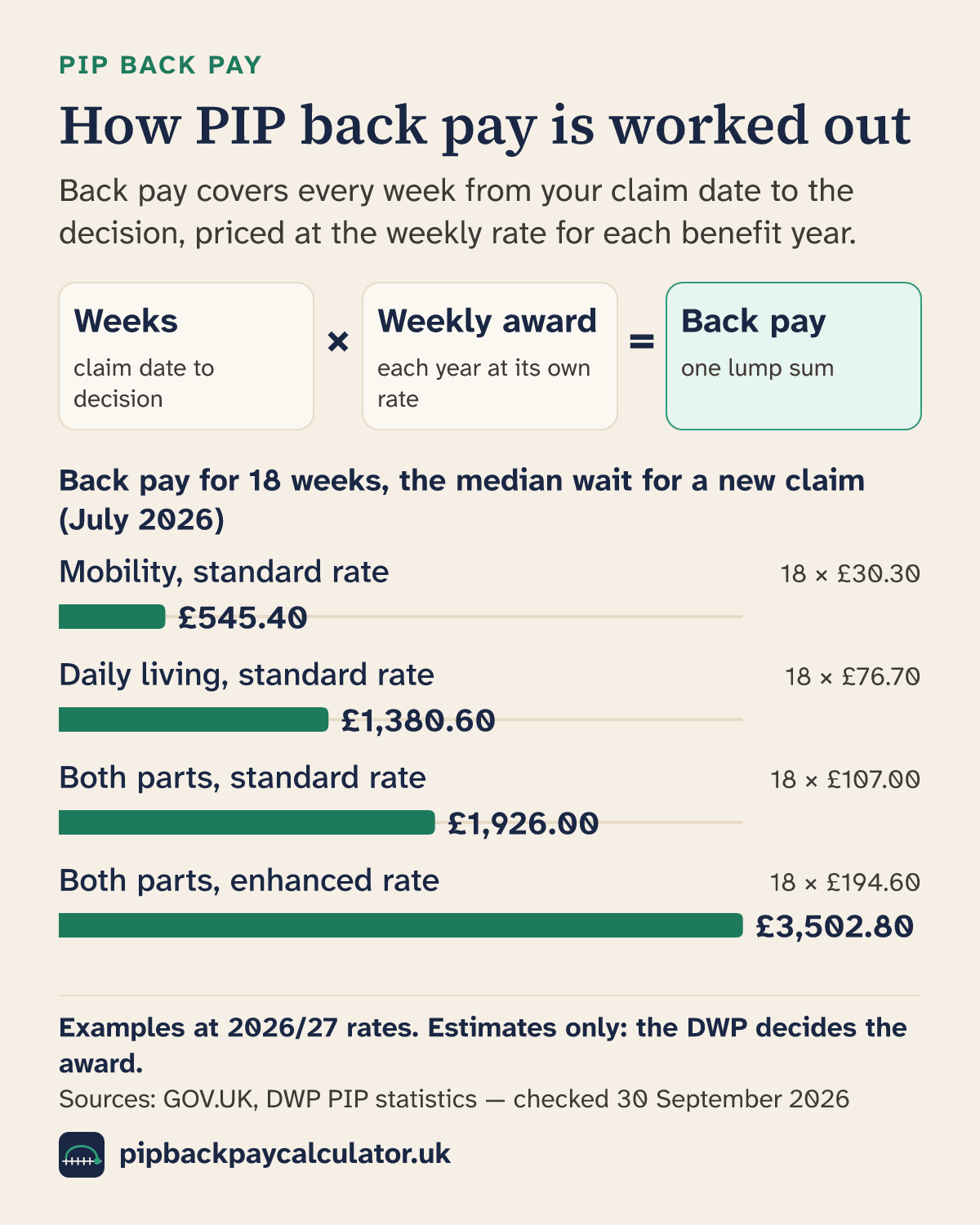
PIP back pay is the weekly award multiplied by the weeks from the claim date to the decision: at 2026/27 rates, the 18-week median wait for a new claim at July 2026 is worth £3,502.80 on the highest award.
Last checked:
Why This Calculator Exists
No official PIP back pay calculator exists on gov.uk, and the manual calculation is tedious enough that most people never check their letter. The waiting alone makes the sums large: the DWP's published median for a new claim was 18 weeks end to end at July 2026, and for initial decisions made between April 2021 and March 2026, 65% of the decisions cleared at a tribunal hearing were revised in the claimant's favour. The rules are public, the rates are published, and the arithmetic is mechanical; what was missing was a tool that assembles them. Searches for a gov.uk version land here because this page does what that page would: applies the official figures to your dates and shows the working.
Last checked:
What Counts as PIP Back Pay
PIP back pay is the money owed for weeks you were entitled but not yet paid, and it exists because awards are decided later than they begin. Every trigger measures its money from a fixed owed-from date:
| Trigger | Back pay runs from |
|---|---|
| New claim awarded | The date you made your claim |
| Mandatory reconsideration success | The date of your original claim |
| Tribunal win | The date of your original claim |
| Review or reported change | The date the change applied |
Last checked:
How Far Back PIP Can Be Paid
Back pay reaches to the date you made your claim, and never to any date before it. The rule protects every waiting week and ignores every pre-claim month, which is why claiming promptly matters more than deciding anything else quickly. A worked example: a claim on 5 January 2026 decided on 22 June 2026 with standard daily living covers 24 weeks, 13 of them at the 2025/26 rate of £73.90 and 11 at the 2026/27 rate of £76.70, producing £1,804.40.
Last checked:
Back Pay After a Tribunal or Reconsideration
Challenged decisions produce the largest back payments, because the owed-from date stays anchored to the original claim while the challenge runs. A tribunal that awards or increases PIP restores every week back to that claim date, at the rates each week carried.
The waits differ by route. The full picture, with worked examples, is in the rules and triggers guide and PIP Back Pay After Winning a Tribunal. Timings for every route sit in How Long PIP Back Pay Takes to Arrive, the reconsideration route in back pay timing after mandatory reconsideration, and the largest sums in Maximum PIP Back Pay.
| Trigger | Money normally arrives |
|---|---|
| New award | Within days of the decision |
| Reconsideration change | Within days of the new decision |
| Tribunal win | Normally 4 to 6 weeks after the decision |
Last checked:
Check Your Points and Rates
Back pay is one of three numbers this site calculates; the other two feed it. The PIP Points Calculator scores the 12 activities to show the award your difficulties support, and the PIP rates tables hold every current and historical figure the estimates use, from 2022/23 to 2026/27.
The Four Scenarios, In Brief
Each scenario the selector offers maps to one owed-from rule, and choosing correctly is most of the accuracy. Every rule turns on the date entitlement arose rather than the date of the decision, and a window crossing an April is priced in segments: enhanced daily living was £110.40 a week in 2025/26 and £114.60 in 2026/27. New PIP award covers first claims: the window runs from your claim call to the decision, at the full awarded rates. Mandatory reconsideration covers changed DWP decisions: from the original claim, paying the full award after a refusal or the difference after an increase. Tribunal covers the same ground with the tribunal's award, reaching back to the original claim however long the appeal took. Review increase covers reported changes: from the date the change applied, paying the difference between old and new.
Claimants between stages can still use the tool forward-looking: enter today as the end date and read what is already owed, then watch the figure grow while the decision is pending. The money accrues whether or not it has been calculated yet.
Reading Your Estimate Against the Letter
The estimate and the DWP's own figure should land close together, and the gaps between them have knowable causes. Scale tells you which cause you are looking at: a full 4-week cycle at the highest combined rate is £778.40, so a gap of a few pounds is the April rounding and a gap of hundreds is a different owed-from date. The tool prices April boundaries at the first Monday on or after 6 April, while the DWP works from your individual pay periods, so results can differ by a few pounds around April. A larger gap usually means a different owed-from date or a different award than you entered, and your decision letter names both. The weekly rates in previous years, back to 2013/14, are listed with the publication each figure comes from.
Use the estimate in the direction it is built for. Before a decision, it turns waiting weeks into a number you can plan around. After a decision, it is the two-minute check that the letter's arrears line looks right, run while the one-month challenge window is open. It is never proof by itself: the letter and your claim record decide, and a mismatch is a question for the enquiry line, not a conclusion.
Three inputs deserve care because they move the result most. The from date should be the day you started the claim, not the day symptoms began. The award should be what the decision or tribunal actually granted, component by component. And for increases, the previous award matters as much as the new one, because only the difference is owed.
DLA, ADP and Other Back Pay
Moving from DLA to PIP creates its own arrears question: the difference between the two awards over the transfer window. The rate structures do not line up: DLA care pays £30.30, £76.70 or £114.60 a week in 2026/27 against PIP daily living's £76.70 or £114.60, and Adult Disability Payment pays the same four rates as PIP. The DLA back pay calculator in the calculators menu handles that comparison at each year's rates, using the DLA care and mobility structure on one side and PIP's components on the other. Scotland's Adult Disability Payment runs on separate rates and a separate system, with its own tools planned for a later wave; until then, Scottish claimants comparing ADP amounts should work from Social Security Scotland's published figures.
Universal Credit, ESA and other benefit arrears follow their own rules and their own timescales, none of which this tool models. What stays constant across every benefit is the principle the PIP rules make explicit: money owed runs from when entitlement began, not from when the decision caught up with it.
Keeping the Estimate Current
The rates are regenerated from GOV.UK and the DWP rate publications rather than typed in, and the verification date shows beneath the calculator. When the April 2027 uprating publishes, the new year is added and every earlier year keeps its own figures.
The rates inside this tool are regenerated from GOV.UK and the DWP rate publications, with the verification date shown beneath the calculator. When the April 2027 uprating publishes, the new figures enter through the same generated data file and every estimate updates at once. Nothing you enter is stored: the calculation runs entirely in your browser, and closing the page clears it. The one thing worth saving is your result alongside the dates that produced it, because the same inputs will reproduce the same estimate whenever you return to check a letter against it.
The estimate is strongest when it is boring: dates from your letters, awards from your decision, and a result that matches the DWP within pounds.