
The Short Answer
Heart Conditions can qualify for PIP where it limits the assessed activities on more than half of the days over a 12-month period. Exertion tolerance is measured in metres, not in ejection fraction. Points come from the descriptors the condition engages, not from the diagnosis, and both components can reach either rate. Eight points in a component pays the standard rate, and 12 points pays the enhanced rate.
How Heart Conditions Affects the 12 Activities
The activities below are the ones whose published assessment guidance names the functions a heart condition is commonly reported to affect.
| Activity | What it assesses | Descriptors typically engaged | Points |
|---|---|---|---|
| Mobility 2 — Moving around | standing and then moving without severe discomfort, which the guidance names as including breathlessness | b, c | 4–8 |
| Daily living 4 — Washing and bathing | washing and bathing, where exertion, bending or heat provoke breathlessness | b, c, e | 2–3 |
| Daily living 6 — Dressing and undressing | dressing and undressing, which involves stretching, reaching and bending | b, d, e | 2–4 |
| Daily living 1 — Preparing food | preparing and cooking a simple meal, including standing at a hob for the length of the task | b, c | 2 |
| Daily living 3 — Managing therapy or monitoring a health condition | managing therapy at home, including anticoagulation monitoring, diuretics and daily weights | b, c | 1–2 |
Last checked:
Where this mapping comes from
Descriptor letters and point values are reproduced from Schedule 1 of the Social Security (Personal Independence Payment) Regulations 2013. The activities listed are the ones whose published assessment guidance names the functions this condition is reported to affect. No activity is listed on any other basis.
Activities are numbered as Schedule 1 numbers them, within each component: daily living 1 to 10 and mobility 1 to 2.
- DWP PIP Assessment Guide, activity 12: “This activity considers a claimant's physical ability to move around without severe discomfort, such as breathlessness, pain or fatigue.”
- DWP PIP Assessment Guide, activity 4: “Consideration should be given to the claimant's functional restrictions to see if they: could reasonably use an aid such as a grab rail to get in or out of an unadapted bath or shower (4B) or whether they require assistance (4E) to get in and out of an unadapted bath or shower.”
- DWP PIP Assessment Guide, activity 6: “Dressing and undressing may involve stretching, reaching, bending, gripping and other such movements.”
- DWP PIP Assessment Guide, activity 1: “If an individual cannot cook at all because they have never needed to learn, consider their ability to carry out activities at or above waist height and their cognitive ability to use a stove or microwave if shown how.”
- DWP PIP Assessment Guide, activity 3: “Examples of therapy include physiotherapy, home dialysis and special diets where both attention to the nature and timing of food is integral in the management of the diet.”
The remaining activities are not closed; they are simply less often engaged. Where a heart condition coexists with another condition, the whole assessment is in play, and a claim described under one heading alone will leave those activities blank.
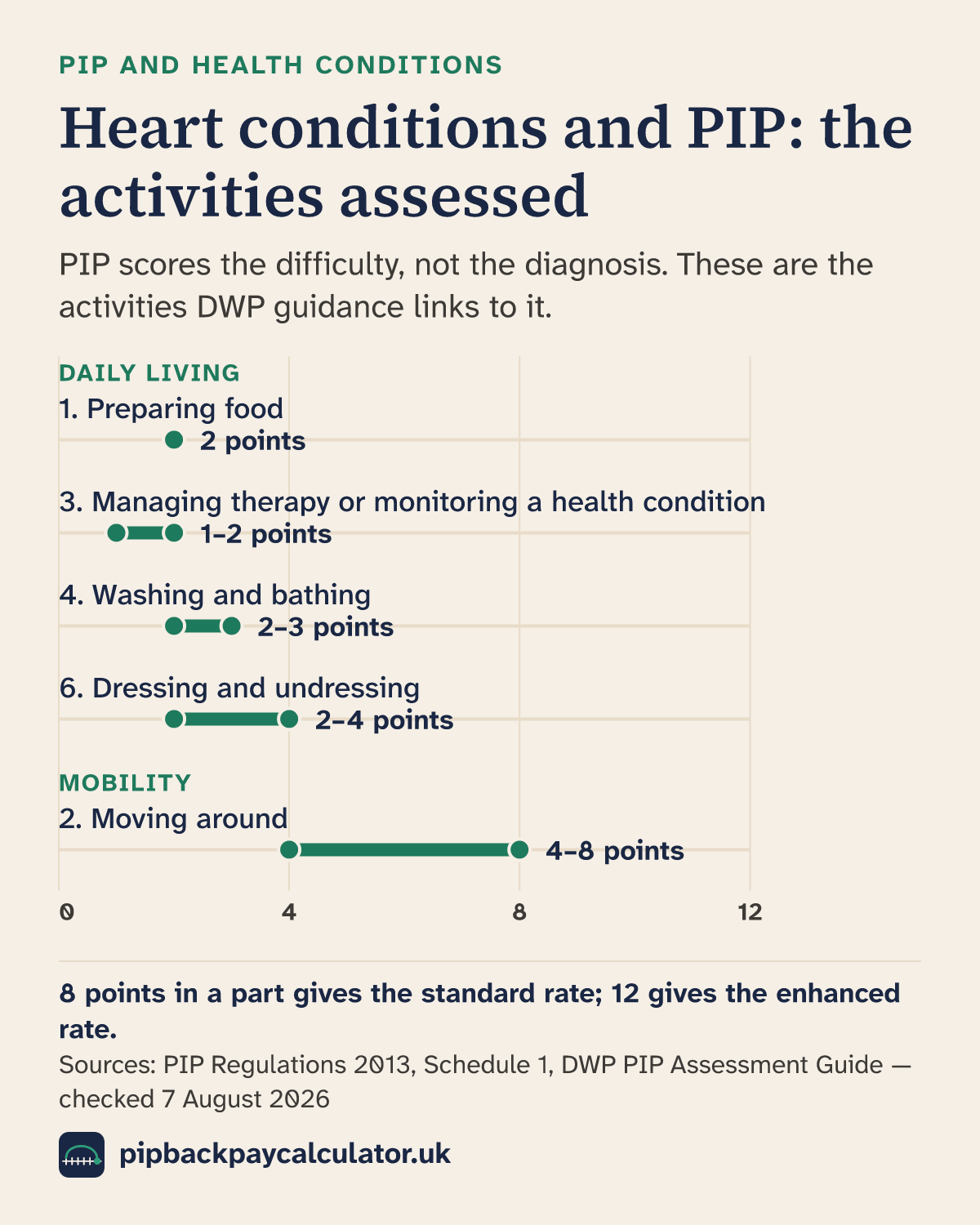
PIP scores a heart condition through the activities it affects, not the diagnosis: the DWP assessment guidance links it to five activities, where the descriptors typically engaged score 1 to 8 points each.
Last checked:
Points You Could Score
8 points in a component pays the standard rate; 12 points pays the enhanced rate. Regulations 5 and 6 of the PIP Regulations 2013 set both thresholds, and the two components are scored separately so their points never combine.
Daily living component (10 activities, scored separately)
- 0 to 7 points
- No award
- 8 to 11
- Standard £76.70
- 12 or more
- Enhanced £114.60
Mobility component (2 activities, scored separately)
- 0 to 7 points
- No award
- 8 to 11
- Standard £30.30
- 12 or more
- Enhanced £80.00
Weekly amounts, 2026/27. Only the highest descriptor in each activity counts; points from different activities in the same component add together, and daily living and mobility points never combine.
Last checked:
Source: PIP Regulations 2013, regulations 5 and 6 (legislation.gov.uk); GOV.UK PIP rates
The moving around distance bands run from 4 points at 50 to 200 metres to 12 points below 20 metres, and the distance that counts is the one managed without severe discomfort. How the 8 and 12-point thresholds apply in each component, with worked totals, is set out in How Many Points You Need for PIP.
To score your own case activity by activity, use the Heart Conditions PIP Calculator, which is pre-filtered to the activities above. A claim that includes a heart condition and sleep apnoea and PIP is scored on the effects of both together. For questions about standing and fainting, PIP and POTS shows how the moving around descriptors treat them.
Evidence and Assessment
Evidence that names an activity beats evidence that names the diagnosis. The diagnosis is rarely disputed; what the descriptors ask about is what happens when you attempt a task.
- A cardiology clinic letter recording the diagnosis, ejection fraction or NYHA class
- A repeat prescription list covering diuretics, anticoagulants, beta blockers and antianginals
- Records of admissions, cardioversions, angioplasty or device implantation
- An exercise tolerance test or six-minute walk test result referenced in a clinic letter
- Cardiac rehabilitation notes, with attendance and the limits recorded
- A dated log of the tasks that provoke breathlessness or chest pain and how long recovery takes
A six-minute walk test or exercise tolerance result referenced in a clinic letter converts a cardiac diagnosis into the measurement the descriptor is written in.
At the appointment itself, the reliability criteria are what to keep in view: an activity counts as done only where it can be done safely, to an acceptable standard, repeatedly and in a reasonable time. Those four elements come from regulation 4 of the PIP Regulations 2013, and each is a separate ground on which a task can fail. What the PIP assessment guide covers, and how to prepare, is set out on the assessment hub.
Rates and Back Pay for Heart Conditions Claims
The same rates as any award, and the same backdating rules.
| Award | Weekly | Every 4 weeks |
|---|---|---|
| Daily living standard | £76.70 | £306.80 |
| Daily living enhanced | £114.60 | £458.40 |
| Mobility standard | £30.30 | £121.20 |
| Mobility enhanced | £80.00 | £320.00 |
Last checked:
An award runs from the date of the claim, so the months spent waiting for a decision are paid as arrears rather than lost. Where a claim is refused and later won at reconsideration or tribunal, the award still reaches back to the original claim date. The weekly and 4-weekly amounts for both components, year by year, are set out under PIP rates.
Where Heart Conditions Sits Among Other Conditions
No condition ranks above another, because the regulations name none of them. Heart Conditions is assessed on the same 12 activities as every other condition, and the list of conditions that can qualify for PIP exists to show how each maps onto those activities rather than to rank them.