
The Short Answer
After winning a PIP tribunal, payment normally arrives within 4 to 6 weeks of the decision. The money comes as one lump sum, backdated to the date of your original claim, because the tribunal's award replaces the DWP's decision from that date. Your regular 4-weekly payments start at the new amount at the same time. A long wait for the hearing means a large lump sum.
Key facts
| Fact | Figure | Source | Checked |
|---|---|---|---|
| Back pay after a tribunal win | Normally 4 to 6 weeks | Citizens Advice | 30 September 2026 |
| Back pay runs from | The date of claim (new claims) | GOV.UK | 30 September 2026 |
| Asking for full written reasons | Within one month of the date of the decision | GOV.UK | 30 September 2026 |
| Back pay and Universal Credit savings | Ignored as capital for 12 months | legislation.gov.uk | 30 September 2026 |
How long after winning PIP tribunal will I get paid?
Citizens Advice puts money after a successful PIP appeal at 4 to 6 weeks from the decision. The tribunal does not pay you itself. It sends its decision to the DWP, and the DWP recalculates your award and issues the pip back payment plus your new regular payments. Each step in that chain is set out in the timeline below.
The 4 to 6 weeks is the normal case, not a fixed deadline. Payment may take longer where the DWP considers appealing on a point of law, or where the award needs manual recalculation across several years. Waiting past six weeks is the point to start chasing.
The waiting weeks also close a chapter with its own paperwork. Keep the decision notice safe: it is the proof of the award until the DWP's own letter arrives, and the reference every chasing call starts from. If your award during the appeal was nil, the first regular payment establishes your payment day as well as your rate, so the decision letter that follows the money is worth reading for its dates as much as its amounts.
The same 4 to 6 weeks applies in 2026: each April changes the rates used to price the back pay, not the wait. The lump sum arrives in one transfer whatever its size. Back pay after a first award or a reconsideration takes a shorter route, compared case by case in processing timescales, and the reconsideration route is covered in back pay timing after mandatory reconsideration.
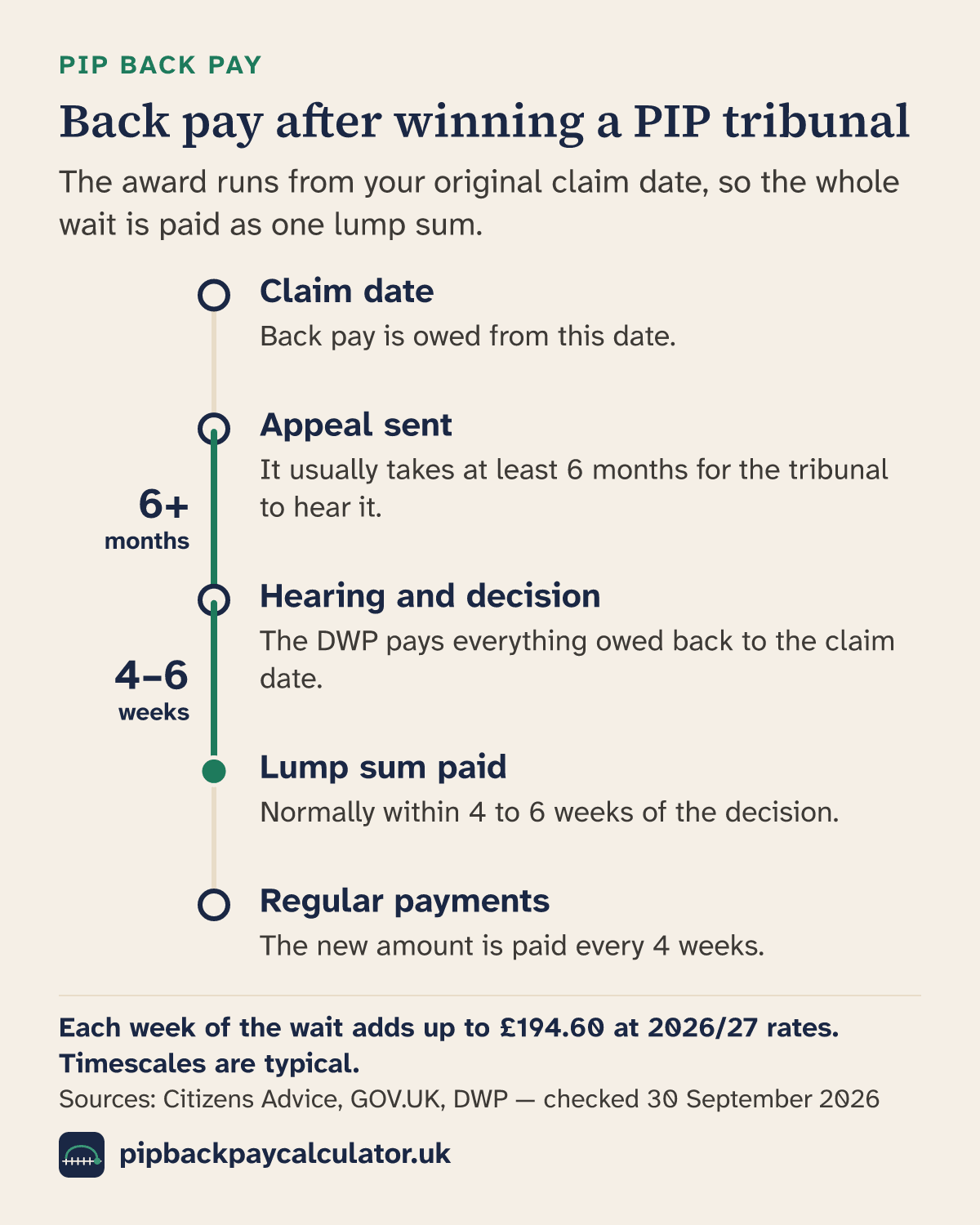
After winning a PIP tribunal, the back pay owed from the original claim date normally arrives as one lump sum within 4 to 6 weeks of the decision, and the new amount is then paid every 4 weeks.
Last checked:
What happens between the tribunal decision and the payment?
Between the decision and the money, the DWP must receive the tribunal's decision and put it into effect, which normally takes 4 to 6 weeks in all. The sequence, step by step:
| Step | Normally when | What you receive |
|---|---|---|
| Tribunal decision | On the day if you attend the hearing, otherwise by post afterwards | The decision notice |
| Written reasons window | Within one month of the decision, either side can ask for full written reasons, the first step towards an appeal on a point of law | Nothing yet |
| The DWP puts the decision into effect | After the tribunal service sends it the decision | A recalculated award and back-pay window |
| Back pay | Normally within 4 to 6 weeks of the decision | One lump sum from your original claim date |
| Regular payments | From then on, every 4 weeks | The new amount |
Last checked:
GOV.UK states that you get the tribunal's decision by post after the hearing, and may get it on the day if you attend. The written reasons deadline and the 4 to 6 weeks come from GOV.UK and Citizens Advice respectively. You can follow the appeal itself online until the decision: GOV.UK's appeal account lets you track its progress, upload evidence and request the hearing's audio recording.
Back Pay Timing in Detail
The amount is the tribunal's award applied to every week since your original claim, priced at each year's rates. A worked example shows the scale. A claimant applies on 10 February 2025, is refused, and wins enhanced daily living at tribunal on 12 October 2026. The back-pay window is 87 weeks.
- Claim made
- Refused
- Mandatory reconsideration
- Appeal
- Tribunal decision
Back pay starts10 February 2025date of claim
Back pay ends12 October 2026tribunal decision
87 weeks of arrears, split at each April uprating
| Benefit year | Weeks | Weekly rate | Back pay |
|---|---|---|---|
| 2024/25 | 8 weeks | £108.55 | £868.40 |
| 2025/26 | 52 weeks | £110.40 | £5,740.80 |
| 2026/27 | 27 weeks | £114.60 | £3,094.20 |
| Total | 87 weeks | £9,703.40 |
- After a tribunal win the lump sum normally takes 4 to 6 weeks to arrive, with regular payments at the new rate from then on.
- An estimate from published rates, not a DWP decision; the April boundary is approximated to the week the new rates apply.
Last checked:
Source: Back-pay engine using GOV.UK and DWP benefit rates by year
If the DWP was already paying something during the appeal, the back payment is the difference between the old and new awards over the window, not the full amounts twice. An award upgraded from standard to enhanced daily living pays the weekly gap, £37.90 at 2026/27 rates, for each week of the wait.
Last checked:
What can slow the payment
Two legitimate pauses can stretch the window. The DWP may request the tribunal's full written reasons, which it needs if it is considering an appeal on a point of law, and it may seek permission for such an appeal within its time limit. Both are uncommon, and neither cancels the tribunal's decision while it stands.
Chasing a payment past six weeks
Six weeks without money is the point where chasing becomes reasonable. Call the PIP enquiry line on 0800 121 4433 with your decision notice to hand, and ask two questions: has the tribunal's decision been received, and has payment been issued. The answers locate the delay precisely. A decision not yet received needs the tribunal service chased instead; a payment issued but not arrived is a bank-details check.
Last checked:
Where calls do not move a stuck payment, a welfare rights adviser or Citizens Advice can escalate, and a formal complaint through the DWP's process creates a written record. The back payment itself is safe throughout: delay changes when the money arrives, never whether it is owed.
Fresh awards and increases run through the same table differently. A refusal overturned outright pays the full award for every week, which is the £9,703.40 shape above. An award the tribunal increased pays the weekly difference, priced at each year's own gap, so the same 87 weeks upgrading standard to enhanced daily living pay £3,208.50 instead. Both arrive the same way, as one transfer, alongside regular payments at the new rate.
Last checked:
The deadlines that led to the hearing still matter afterwards. You reached the tribunal within one month of your mandatory reconsideration notice, and the DWP faces its own time limits if it wants to challenge the decision. Once the money lands, checking it against the table method above catches recalculation errors while they are easy to raise. What happens next with reviews and award lengths is covered in After Winning a PIP Tribunal, and how large a tribunal lump sum can grow is set out in Maximum PIP Back Pay.
A final framing keeps the wait proportionate: the 4 to 6 weeks after winning is the shortest stage of a journey that took months, and it is the only stage with money moving at the end of it. Chase it when it overruns, and let it run when it does not.
Win first, then count: the order matters, and this page exists for the counting.
From hearing room to bank account, the route is short, tracked, and normally six weeks at the outside; everything larger about the win happened in the hearing itself.
The estimate method above tells you what to expect while the wait runs.
Work Out Your Number
Enter your claim date, the tribunal date, and the award the panel made. The estimate prices every week at its own year's rates: work out your pip back pay.